|
|
When a bad zoo gets shut down, there’s not always a plan for the animals.
|
|
|
|
|
Voices and updates from the front lines of wildlife crime and exploitation of nature
|
|
|
|
|
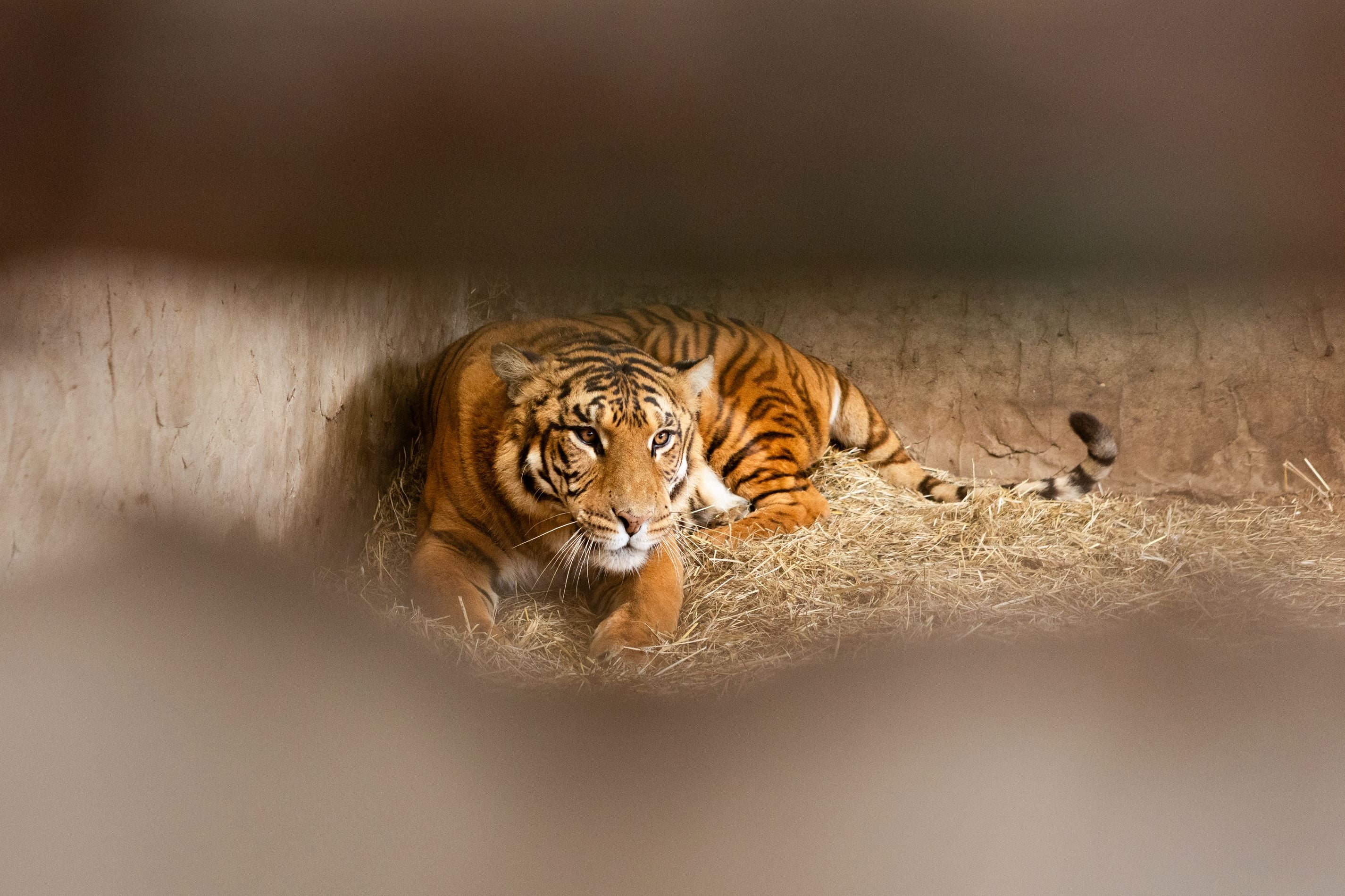
Some of the lions and tigers rescued from the Luján Zoo in Argentina had spent most of their lives in unlit concrete enclosures. (Courtesy Hristo Vladev/Four Paws)
|
|
|
|
|
By Rachael Bale
October 9, 2026
|
|
|
|
|
In the eastern plains of Colorado, miles from the Rocky Mountains is a sanctuary for wild animals. It’s called The Wild Animal Sanctuary. Its huge, fenced habitats stretch across the prairie beneath a wide-open sky. Bald eagles often circle overhead, looking for prairie dogs. Here, lions, tigers, bears, wolves, and other animals with sharp teeth live in peace.
They came from roadside zoos, backyards and basements, circuses, and war zones. Together, The Wild Animal Sanctuary and its extension facility farther south, The Wild Animal Refuge, are home to hundreds of rescued animals.
Among the newest residents are eight tigers and seven lions from Luján Zoo outside Buenos Aires, where some had lived in almost complete darkness. The rescue, a complicated international operation that ultimately transferred 30 big cats to the U.S. and South Africa, was orchestrated by the nonprofits Four Paws and The Wild Animal Sanctuary (TWAS).
“We can never fully replicate these animals’ natural habitats or erase the harm that has been caused to their bodies and minds through the stress and constraints of captivity,” says Kendra Coulter, a professor and head of Huron University College’s animal ethics and sustainability leadership program, in Ontario. “But some organizations have built strong reputations as necessarily imperfect but ethically rigorous options.”
Luján Zoo was shut down by authorities in 2020 amid complaints of animal neglect and safety violations. Visitors had been allowed to feed, pet, and even sit on some of its big cats, who were bred repeatedly to ensure a supply of cubs for photo ops. After the shutdown, the estimated 200 big cats—and the rest of the zoo’s animals—had nowhere to go. A mostly volunteer crew of former staff kept them alive as best they could. Though they clearly cared about the animals, says Four Paws’ Luciana D’Abramo, they’d never been properly trained. Nor had the animals ever had necessary veterinary care. They were in terrible condition.
By the time Four Paws started investigating, in 2022, only 112 big cats remained.
|
|
|
|
|
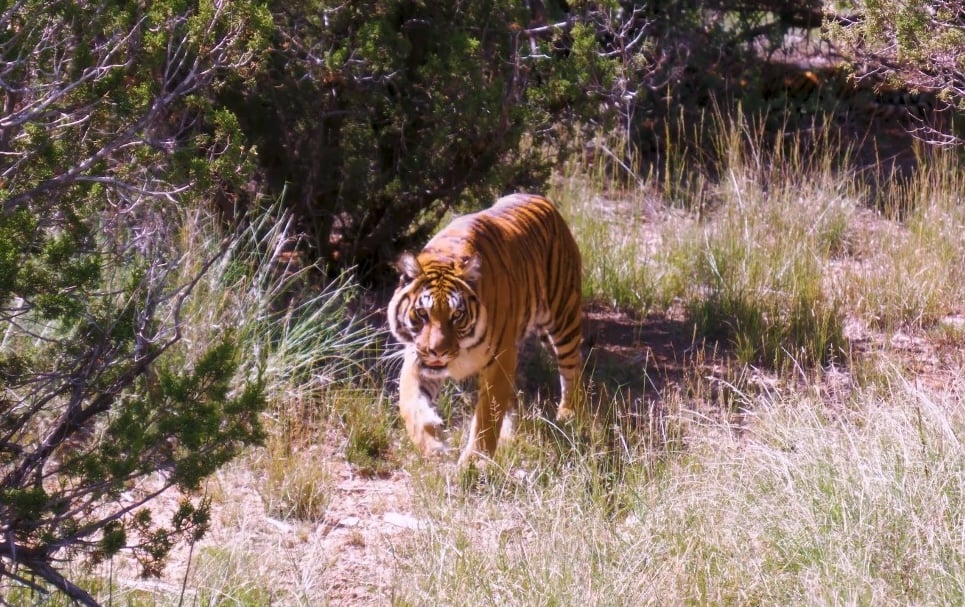
Rescued tiger Patrick roams his new enclosure in Colorado. (Courtesy The Wild Animal Sanctuary)
|
|
|
|
|
In September 2025, the zoo’s owner, Jorge Semino, finally agreed to let the organization take over the animals’ care.
By then, there were 62 big cats.
D’Abramo was on a video call with the team that arrived to assess the situation. They found that most of the lions and tigers were kept in two areas: “One of them we named the ‘dark sector,’” she says. It was an all-cement hallway of small cages and virtually no light. “Then there was another part that we called ‘the corridor,’” because the row of cages never seemed to end. “It was beyond imaginable,” she says.
Four Paws’ animal care staff got to work triaging the animals. Some had been declawed improperly and could barely walk; some had injuries from fighting each other or tooth infections; some in the “dark sector” had vision problems; some had neurological problems. Most of them had metabolic bone disease and kidney problems from a lifetime of malnutrition.
|
|
|
|
|
Did a friend forward this newsletter to you?
|
|
|
|
|
|
|
|
|
For two straight weeks, they worked to stabilize their health. They performed emergency surgeries and treated injuries and infections, as well as vaccinated and microchipped the animals.
They had to get the cats out of Luján, but where do you put 62 lions and tigers? There aren’t many sanctuaries in the world that take big cats, and even fewer with the space for so many.
‘We’ll take all of them’
Four Paws got in touch with The Wild Animal Sanctuary, which they’d worked with before. “When they reached out, we said, ‘We’ll take all of them,’” says Danika Oriol-Morway, the chief rescue and programs logistics officer of The Wild Animal Sanctuary. “We already have a lot of habitats. We always keep a certain number open, and we’re constantly building, so if there’s ever a crisis, we can say, ‘Come on in.’”
Habitats there range from three to 300 acres, set either on the grassy prairie (The Wild Animal Sanctuary) or on a more rugged, high-plains landscape with canyons, arroyos, rocky bluffs, and woody shrubs (The Wild Animal Refuge). Each typically has insulated underground dens, ponds or pools, climbing structures, and other interactive elements.
Preparations for the rescue began.
No airlines in South America have regularly scheduled direct flights to Denver, so Four Paws chartered a flight with LATAM.
In Colorado, The Wild Animal Sanctuary was working with the airline and Denver International Airport to coordinate the flight’s arrival. They needed to get permission from the airport for the LATAM flight to use the airspace and land on the tarmac, and they had to find cargo handlers and get permission to use a cargo warehouse. Oriol-Morway was also working with the U.S. Fish and Wildlife Service to expedite the thousand-plus pages of permit applications. Special permission was needed for the cats to land directly in Denver, which doesn’t allow the import of live animals that haven’t been inspected and cleared at another U.S. airport first.
Ultimately, Argentina’s government approved the export of 15 lions and tigers to Colorado and another 15 to Four Paws’ Lionsrock Big Cat Sanctuary in South Africa. The others would have to stay behind. “We are caring for them in the former Lujan Zoo, continuing to improve their care and welfare,” D’Abramo says. “We are looking for different solutions for them.”
|
|
|
|
|
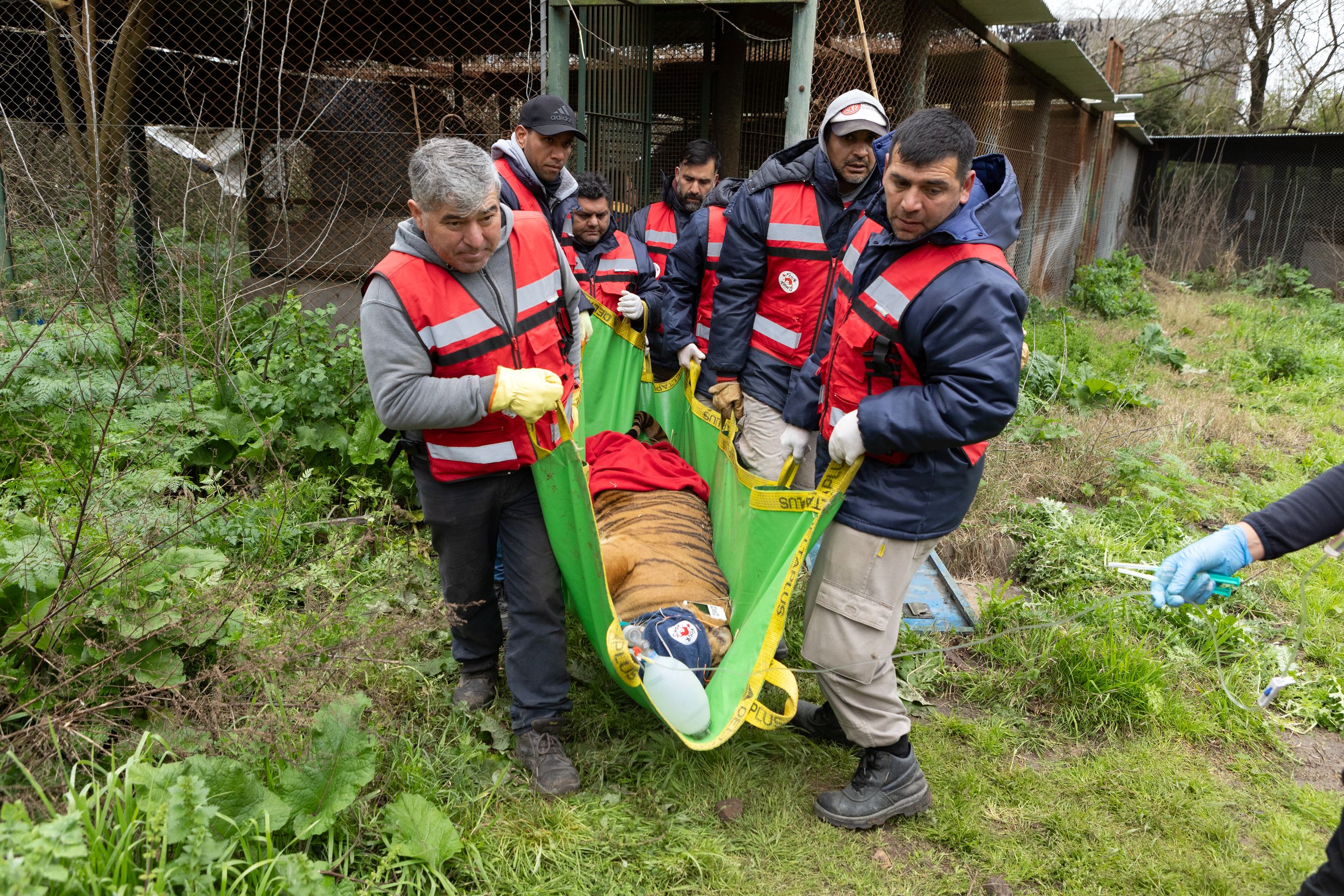
Four Paws staff and volunteers move a sedated tiger to its travel crate for the international flight to The Wild Animal Sanctuary. (Courtesy Hristo Vladev/Four Paws)
|
|
|
|
|
After months of preparation, the time arrived. “It was completely crazy in terms of logistics,” D’Abramo says. The 30 cats would be divided over three flights, with three different layovers and two final destinations—Denver and Johannesburg. In the weeks leading up to the big day, the team had to prepare the crates, finalize the paperwork, and choreograph their moves—and all contingencies—to the minute.
The night before the flights, they loaded the animals safely onto the trucks for the trip to the airport. “We took a moment to take a breath and hug one another,” D’Abramo says. Anesthetizing and crating them was the riskiest part of the operation. Big cats are notorious for going into systems collapse from stress, and combined with the effects of immobilizing drugs, which slow heart rate and breathing, a lot of things could go wrong.
“People think that flying is the highest level of risk,” she says, “But when you’re moving [big cats around], when you’re working with anesthesia, the risk is really high.”
The arrival
In Denver, where the LATAM cargo plane with 15 of the lions and tigers would be landing, Oriol-Morway had to have their side of the operation perfectly choreographed too. “It’s a long flight,” says Oriol-Morway. Almost 16 hours, in fact. “The longer an animal stays in a cage, the more stress they have, and the higher the risk of medical crisis. ”
|
|
|
|
|
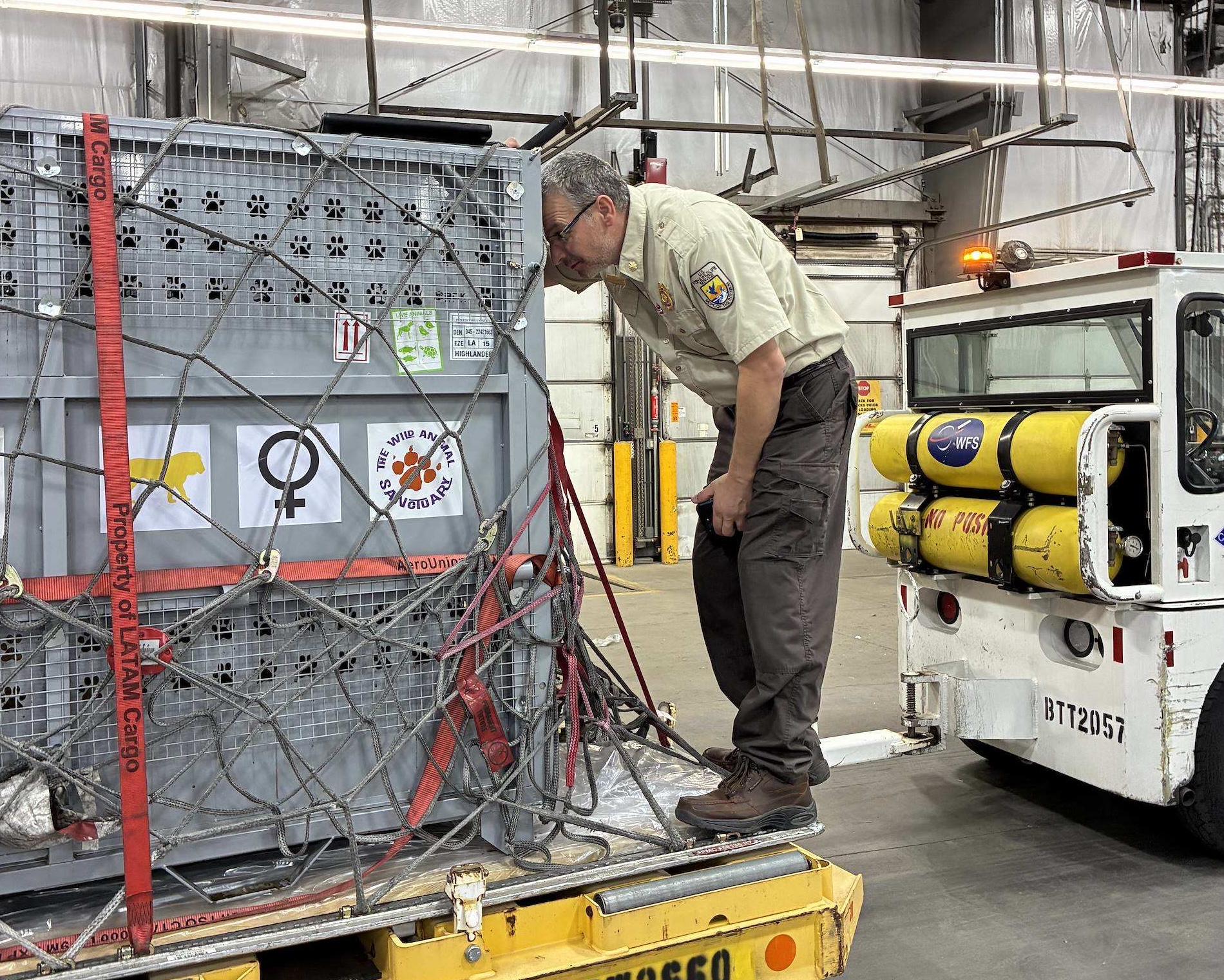
Wildlife inspector John Rosloniec, with the U.S. Fish and Wildlife Service, looks in the crate of a big cat that just arrived at Denver International Airport. (Courtesy U.S. Fish and Wildlife Service)
|
|
|
|
|
Oriol-Morway and the U.S. Fish and Wildlife Service team, who would inspect the cats and review their permits upon arrival, met outside the cargo warehouse around 10 p.m. All day, the flight’s arrival time had been fluctuating. “Everyone’s got their coffee. And then, ‘Oh, no—it’s landing at 1 a.m.,’” Oriol-Morway says.
“All of us [were] watching lights in the sky. Is that the one? Is that the one?” says the Fish and Wildlife Service’s Taliah Farnsworth. “Finally we saw the one.”
Customs did the security check, and Fish and Wildlife Service wildlife inspector Holli Polansky made sure the airline had fulfilled the standard humane transport regulations.
Then a scissor lift lowered two crates at a time from the airplane to a cargo dolly on the tarmac. An airport tug pulled it to the warehouse, where sanctuary staff gave each cat a once-over through the crate’s paw-shaped view holes. Polansky and wildlife inspector John Rosloniec checked the paperwork. A forklift took the crates to the trailers.
The whole thing took about two hours, Oriol-Morway says. “I don’t relax until I watch the animals depart the airport,” she says. “Once I can see the trailer trucks pull out, then I know they’re in the hands of my animal care director, and she’s on it.”
High on adrenaline, Oriol-Morway got home round 4:00 a.m. and walked her dog. By the time the sun came up, the cats would be at their new home.
That was seven weeks ago. Today the lions and tigers are all doing well, Oriol-Morway says. Some have paired off with new companions; others are still learning to get along with each other. But they all have full bellies, grass to run through, and all the sunlight they could want.
|
|
|
|
|
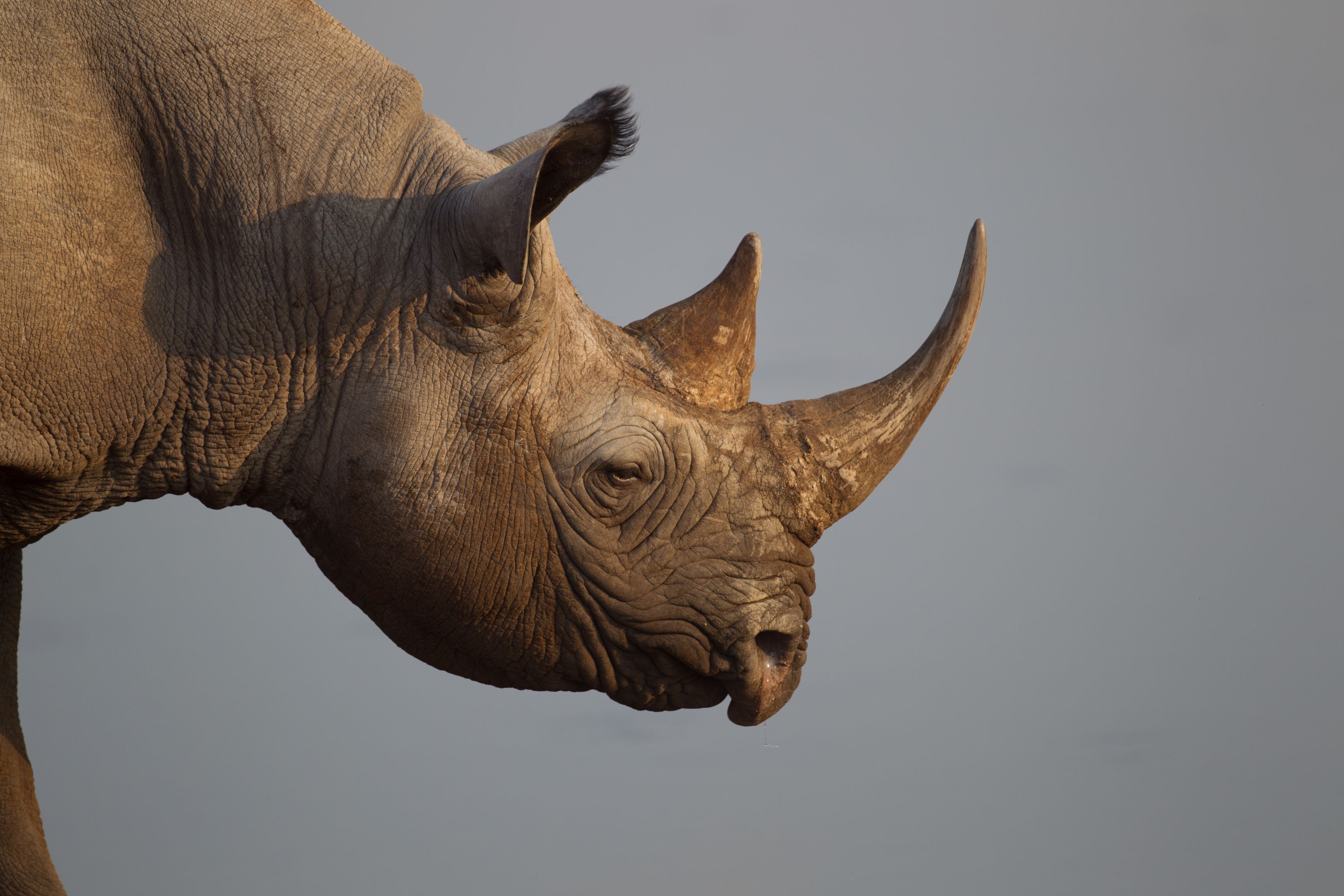
South Africa, home to most of the continent’s remaining rhinos, is a major source of horn trafficked to Asian markets for traditional medicine. (Yathin Krishnappa)
|
|
|
|
-
Arrested: South Africa’s elite Hawks police unit arrested a fifth suspect allegedly involved in a scheme to cover up rhino horn trafficking. Nguyen Huu Dong, a Vietnamese national and manager of the Voi Wildlife Lodge, stands accused of staging an armed robbery in which he claimed thieves tied him up and stole a stockpile of 98 rhino horns, almost $3,000 in cash, and cell phones. Officials allege the robbery was faked to conceal the disappearance and sale of the rhino horns. Dong is the cousin of Chu Dang Khoa, an alleged ringleader of a transnational wildlife trafficking syndicate.
-
Ape update: Four of the six young apes rescued last month from wildlife traffickers in Nigeria are stable and recuperating well, according to primatologist Lindsay Maess, who is overseeing their care. After being seized from traffickers and stabilized in Kano, the apes were transported 18 hours by road to a rehab center in an undisclosed secure location within the country. “Their personalities are blossoming, and they’re gaining confidence by the day, which I think is the first sign that you know they’re on the road to recovery,” Maess says. “They're eating more varieties of food, they’re chewing on leaves on forest walks, and they’re also starting to interact with each other more.” For Maess, “this is what progress looks like from a rehabilitation standpoint.”
-
Viral threat: A recent study published in PLOS ONE suggests that people in Vietnam who raise bats, bamboo rats, civets, and wild boars—for pets, food, and traditional medicine—may be exposed to multiple animalborne viruses. Among 207 farmers who provided blood samples, roughly 27 percent had hepatitis E antibodies, and nearly 9 percent had hantavirus antibodies. Researchers caution that they have not determined how the farmers were exposed or whether the viruses came from the animals they raise.
-
Deep dive: The Earth Journalism Network is launching a cross-border reporting project, Mining the Unknowns, with journalists across Asia and the Pacific to investigate the growing push to mine the deep ocean. The initiative supports reporting on deep-sea mining and its potential environmental and economic consequences. It includes an interactive map tracking ocean mining activity across the region, providing a visual guide to an industry developing largely out of sight, thousands of feet beneath the sea.
|
|
|
|
Strange, but true
Some falcons have passports. The United Arab Emirates began issuing them in 2002 so registered falcons could cross international borders without their owners having to repeatedly obtain new permits from CITES, the international treaty governing trade in wildlife. The birds can even fly as passengers on commercial flights: Qatar Airways allows up to six falcons—hooded and tethered—in the economy cabin.
The passport system was introduced in part to combat the problem of wildlife trafficking. A January 2026 investigation by The Guardian and Arab Reporters for Investigative Journalism revealed a growing problem: Poachers are collecting peregrine chicks from nests in the UK to supply wild racing falcons to the Middle East.
|
|
|
|
Like this newsletter? Share it!
|
|
|
|
|
|
|
|
Support WIRE
WIRE runs on curiosity, persistence, and generous support from people who care deeply about what happens to wildlife when no one else is watching. Investigative reporting takes time, expertise, and financial resources, especially when stories cross borders and powerful interests. Our work is funded by readers like you who believe these stories matter. Monthly supporters give us the stability to report deeply, publish independently, and follow the consequences of our investigations. If that resonates, you can support our work here:
|
|
|
|
|
|
|
|
|
Wildlife Investigative Reporters & Editors
Independent, nonprofit journalism exposing wildlife crime and exploitation of nature.
Get in touch: [email protected]
|
|
You received this email because you signed up on our website or made a donation.
|
|
|
|
|
|